








On July 1, 2026, flags fluttered along the shores of Victoria Harbour, where the Five-Star Red Flag and the Bauhinia regional flag stood side by side in vibrant harmony. 29 years ago on this day, Hong Kong returned to the embrace of the motherland. Over the past 29 years, Hong Kong and Shenzhen have moved forward together through changing times, connected by a shared bay and a bond of mutual development. The two ports complement each other's strengths and shine in tandem. Through institutional innovation and policy coordination, they have fully leveraged Shenzhen's unique advantage as the only Chinese mainland city directly connected to Hong Kong by both land and sea, as well as Hong Kong's distinctive strengths under "One Country, Two Systems" as a "super-connector" between China and the world. These advantages have enabled Hong Kong to better integrate into and serve the country's overall development strategy, while jointly advancing the high-quality development of the Greater Bay Area. As a pioneer in Hong Kong–Shenzhen cooperation for more than 32 years, YANTIAN was born from this partnership and has flourished through it.
A Feeder Service Linking 32 Years of "Two-Way Connectivity" Between Shenzhen and Hong Kong
The "waters" between Shenzhen and Hong Kong have always been in motion. The feeder service between YANTIAN and Hong Kong has been operating for over 32 years. What began as one-way transportation has evolved into today's "two-way connectivity," now operating more than six sailings per day on average. The operational linkages between the ports of Shenzhen and Hong Kong have grown increasingly close. Over the past 32 years, container throughput has maintained steady annual growth, and in recent years has accelerated into a "fast lane" of development:
l Following a nearly 30% year-on-year increase in laden container volume in 2024, throughput rose a further 10% in 2025, setting a new historical record.
l In the first half of 2026, both total throughput and laden container throughput recorded double-digit year-on-year growth, reaching historic highs for the same period.
At the policy level, cooperation between the Shenzhen YANTIAN–Hong Kong Kwai Tsing has been incorporated into Guangdong Province's transportation development strategy and Shenzhen's 15th Five-Year Plan, with YANTIAN as the only port explicitly designated for cooperation with Kwai Tsing Container Terminals. In March 2025, the Guangdong Three-Year Action Plan for High-Quality Transportation Development (2025–2027) was issued, calling for strengthened cross-border transport connectivity with Hong Kong and Macao, and further deepening port cooperation between YANTIAN and Kwai Tsing. In May 2026, the Shenzhen Economic and Social Development 15th Five-Year Plan Outline further emphasised strengthening cooperation between YANTIAN and Kwai Tsing, and enhancing both waterborne and land-based transshipment capacity.
To accommodate the sustained and significant growth in feeder throughput, supporting infrastructure has been continuously expanded and upgraded. Last month, YANTIAN put into operation two remotely controlled quay cranes specifically designed for feeder operations, marking the first application of remote-control technology in a feeder operation scenario. An additional five quay cranes will also be introduced in due course. Guided by the principle of "moderate forward-looking investment," these efforts aim to provide robust support for Shenzhen–Hong Kong feeder transport, as well as for APEC regional and global trade growth.
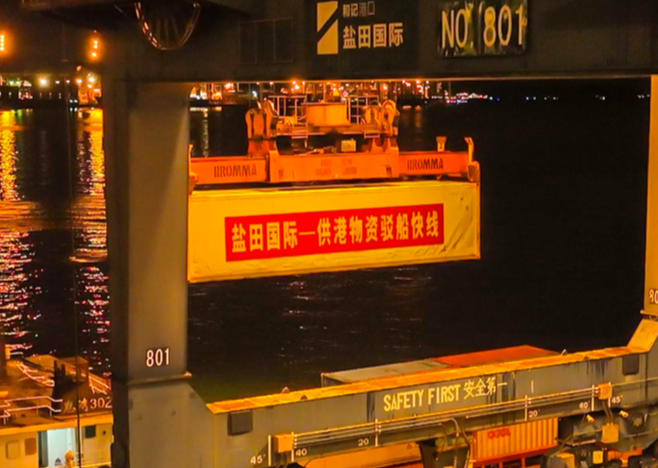
Photographed at YANTIAN, during the COVID-19 pandemic in 2022, YANTIAN worked in coordination with the frequent sailings of the Kwai Tsing–YANTIAN feeder service to establish a dedicated maritime "daily express" for essential supplies to Hong Kong, ensuring the stable supply of livelihood materials and supporting epidemic prevention and control needs.
The YANTIAN–Kwai Tsing synergy now extends across major global ports and shipping services. Leveraging YANTIAN's dense network of services to Europe and North America and Kwai Tsing Container Terminals' well-established Asia and South American service network, the two ports fully complement each other's service advantages. This deepened Shenzhen–Hong Kong port and shipping cooperation enables mainland cargo to seamlessly connect through both hubs into the global shipping network, helping enhance Hong Kong's port throughput and further consolidate its position as an international shipping centre.
A Railway Line Brings the Advantages of Shenzhen–Hong Kong Cooperation Directly to Inland Enterprises' Doorsteps
The reach of Shenzhen–Hong Kong cooperation has long extended beyond the Greater Bay Area, deep into the vast central and western hinterlands of China.
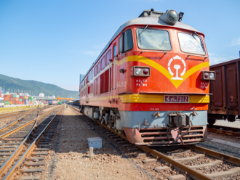
In the "2023 Hong Kong Enterprises Tour to Chongqing," an event organised by the Hong Kong Trade Development Council and Chongqing Commerce Committee, YANTIAN first introduced the concept of the Chongqing-Shenzhen-Hong Kong Express which transports cargoes from Chongqing by rail to YANTIAN, and then by feeder services to Kwai Tsing Container Terminals for connection to international shipping services. Just two months later, the first batch of Chongqing export cargo was shipped via this corridor to Brazil. In August 2024, the Chongqing-Shenzhen-Hong Kong Scheduled Rail-Sea Service was officially launched, reducing transit time from the Chengdu–Chongqing region to YANTIAN from 5–6 days to 2 days, and to Kwai Tsing Container Terminals in just 3 days.
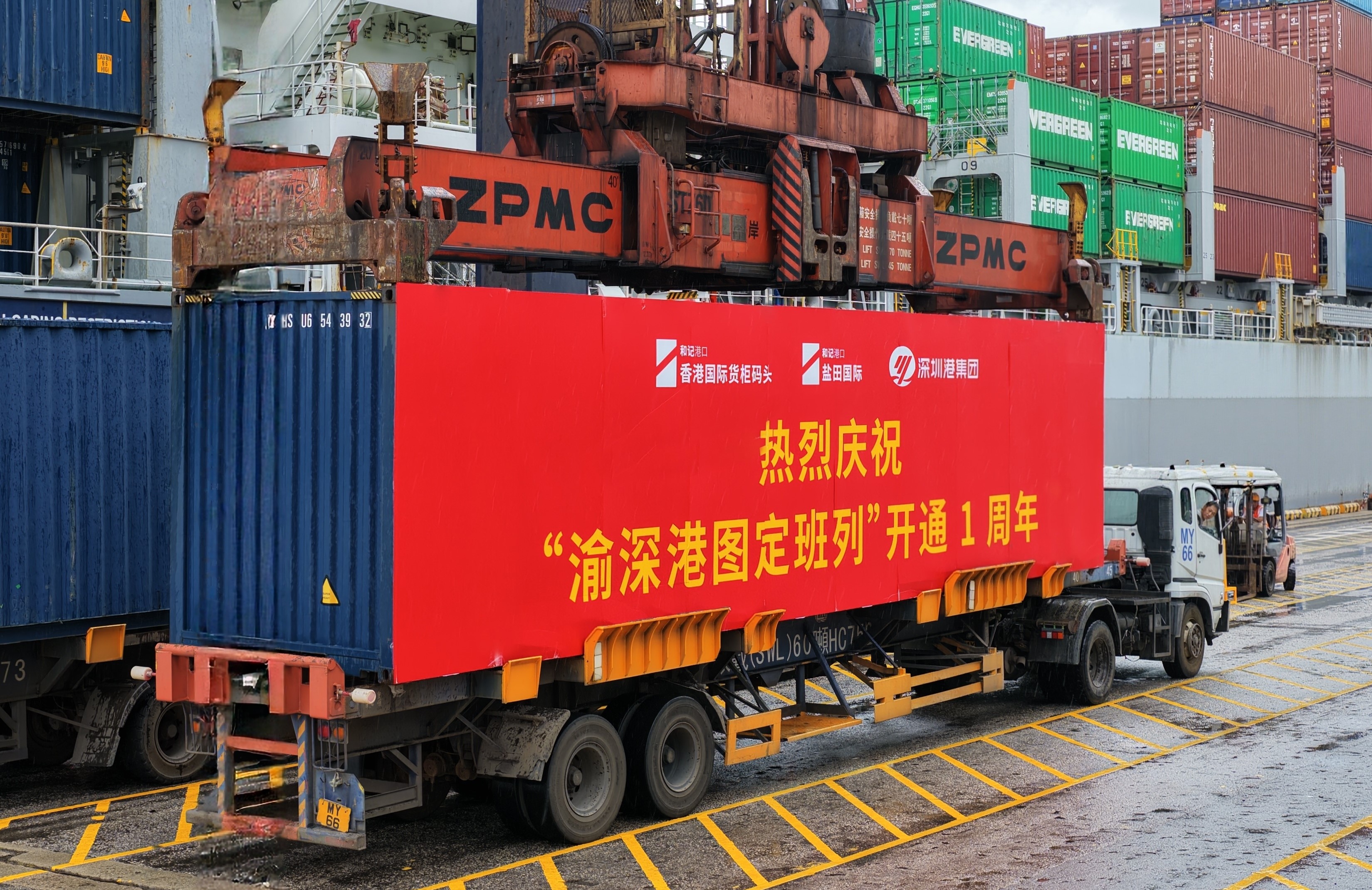
Photographed at Hongkong International Container Terminals (HIT). In August 2025, marking the first anniversary of the Chongqing-Shenzhen-Hong Kong Scheduled Rail-Sea Service, a full train of Made-in-China cargoes departed from Chongqing to YANTIAN, with transit time reduced from 5 days to 2 days. The cargo was then transferred via the YANTIAN–Kwai Tsing feeder service, arriving at HIT on the third day for onward shipment on international vessels.
This proven model has been rapidly replicated and expanded. Within its first year of operation, the Chongqing-Shenzhen-Hong Kong Scheduled Rail-Sea Service had seen freight volume increase 28-fold year-on-year, with total cargo value surpassing CNY448 million. By fully leveraging the complementary service advantages of YANTIAN and Kwai Tsing Container Terminals, it provides inland foreign trade enterprises with a stable, efficient, and low-carbon "golden corridor" to the world—turning the historic "hard road to Shu" into a global gateway for win-win cooperation. Transit efficiency has improved by 60%, overall logistics costs have been reduced by 30%, and on-time performance has remained above 98%, delivering mutual benefits across inland regions, Shenzhen, and Hong Kong.
The Chief Executive's 2025 Policy Address of the Hong Kong SAR, released in September last year, specifically highlighted Hong Kong's efforts to attract cargo from inland regions such as Chengdu. Under this model, cargo is transported via rail-sea services to YANTIAN, transferred by feeder services to Kwai Tsing Container Terminals, and then loaded onto ocean-going vessels bound for international markets, delivering mutual benefits and win-win growth opportunities for both cities. In December last year, YANTIAN was honoured with the "Outstanding Service Award" jointly presented by relevant authorities of the Sichuan Provincial Development and Reform Commission and the Chongqing Municipal Government, making it the only terminal officially recognised by the Sichuan-Chongqing region. YANTIAN is also the only port in South China to have achieved the industry's highest accreditation, the prestigious "Five-Star Multimodal Transport Operator" certification.
One-time Pilotage Clears the "Last Mile" of Mirs Bay
As logistics corridors continue to expand, the Shenzhen–Hong Kong port and shipping sector has also achieved a breakthrough in navigational efficiency. Due to the unique geographical conditions of Mirs Bay, vessels bound for YANTIAN must pass through Hong Kong waters. The mandatory pilotage system introduced in 2020 once resulted in a "double pilotage" arrangement, reducing efficiency, increasing navigational risk, and raising logistics costs.
After multiple rounds of coordination among the governments of Shenzhen and Hong Kong, maritime authorities, and pilotage organizations, the Framework Agreement on the Pilotage Cooperation in Mirs Bay was formally signed on March 15, 2022 by the Transport Bureau of Shenzhen Municipality and the Marine Department of the Hong Kong SAR. This marked the first in-depth governmental cooperation on pilotage within the Greater Bay Area aimed at facilitating port development. Under the agreement, pilotage qualifications between the two sides became mutually recognised, setting a benchmark for regulatory alignment and institutional coordination between Shenzhen and Hong Kong. The framework was renewed in 2025, with the new agreement taking effect on June 1, 2025, for a three-year term. The continuation of this "three-year commitment" signals that Shenzhen–Hong Kong pilotage cooperation has entered a stage of normalised and sustained development, further advancing high-quality port development in the Greater Bay Area.
The naturally advantageous conditions of the Mirs Bay waterway—its wide waters and safe navigational environment—provide a solid foundation for the implementation of the one-time pilotage arrangement. This innovation has effectively reduced vessel turnaround time, improved operational efficiency, enhanced navigational safety, and lowered logistics costs, significantly facilitating the efficient flow of vessels within the Greater Bay Area while further promoting regional economic integration and coordinated development.
Riding the Momentum from a New Starting Point to Seize New Opportunities in the Asia-Pacific
This year marks the first year of the 15th Five-Year Plan period. The national 15th Five-Year Plan explicitly calls for consolidating and enhancing Hong Kong's status as an international financial, shipping, and trade centre, reflecting the country's high-level strategic commitment to the development of the port and shipping sector. This provides a solid policy foundation and strong growth momentum for Shenzhen–Hong Kong port and shipping cooperation. The Plan also emphasises promoting balanced import and export development, creating important opportunities for Shenzhen and Hong Kong to leverage their respective strengths, expand imports from a new starting point, and advance high-standard opening-up at a faster pace.
In addition, the Plan supports accelerating the development of the Northern Metropolis, a strategic initiative introduced by the Hong Kong SAR Government. The Hong Kong SAR Government is actively formulating its first five-year development plan in alignment with national strategies. YANTIAN should fully seize the development opportunities of the Northern Metropolis, make full use of the natural deep-water advantages and complementary strengths in port and logistics industries of both Hong Kong and Shenzhen, activate the functional potential of the Shenzhen–Hong Kong port economic belt, and build a new high-level platform for port and shipping cooperation.
This year also coincides with Shenzhen hosting the 33rd APEC Economic Leaders' Meeting, placing the city at the centre of global attention and highlighting the close collaboration between Shenzhen and Hong Kong in advancing the development of the Greater Bay Area. With strong coordination across the port and shipping sectors of both cities, the two sides are well positioned to fully leverage their world-class strengths in road, rail, air, and sea connectivity, and further strengthen "connectivity across domestic and international markets." This will advance the "hard connectivity" of infrastructure, the "soft connectivity" of rules and mechanisms, and the "heart-to-heart connectivity" between the two cities, driving a leap from a "Shenzhen–Hong Kong cross-border corridor" to an "Asia-Pacific cooperation hub," and fully supporting the stable and efficient flow of global industrial and supply chains.