









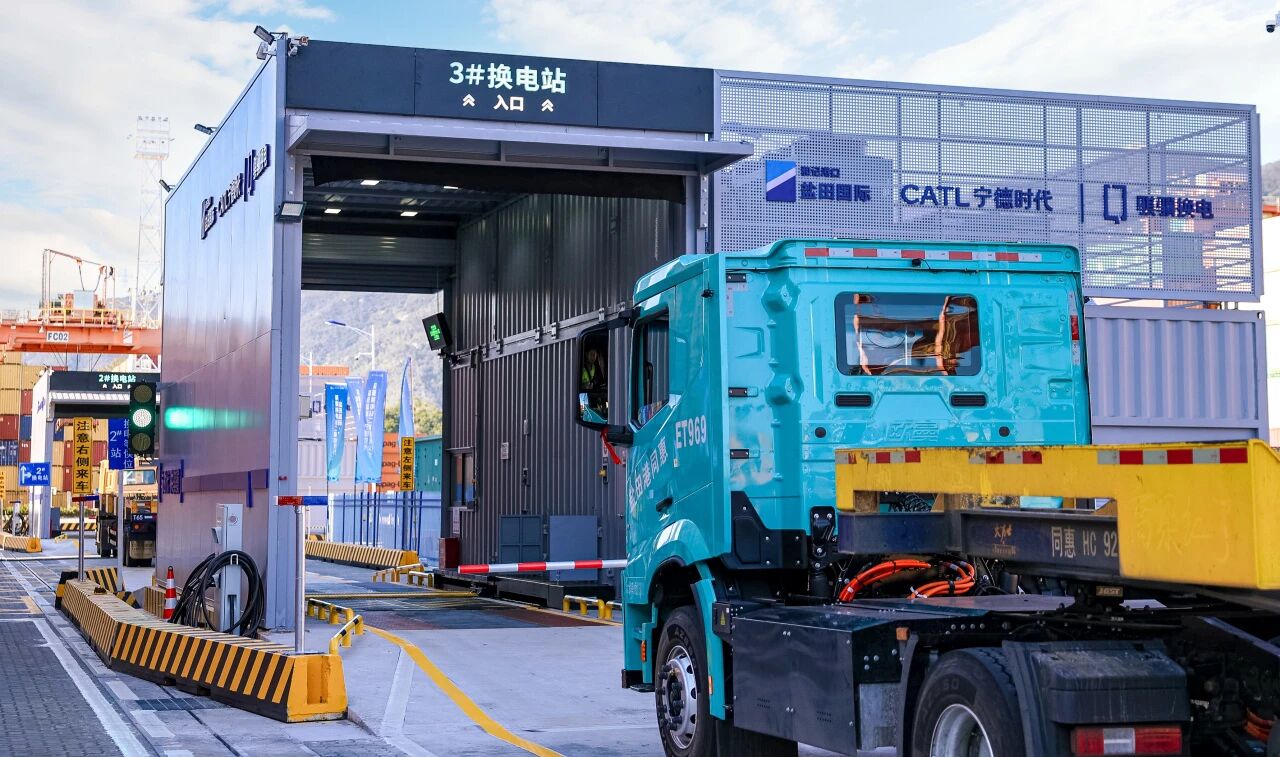
On January 8, 2026, with the strong support and professional guidance of governments and relevant authorities at all levels, Phase II of the battery swap station project jointly developed by YANTIAN and CATL Qiji was officially commissioned. Battery Swap Stations No. 2 and No. 3 were put into operation simultaneously. Together with the already operational Station No. 1, the project has now formed a large-scale, "three-station simultaneous operation" model, marking a solid step toward establishing the world's largest port-based network of chassis-type battery swap stations. This milestone also represents another significant advance in Shenzhen's port sector as it accelerates green and low-carbon transformation and cultivates new drivers of sustainable growth.
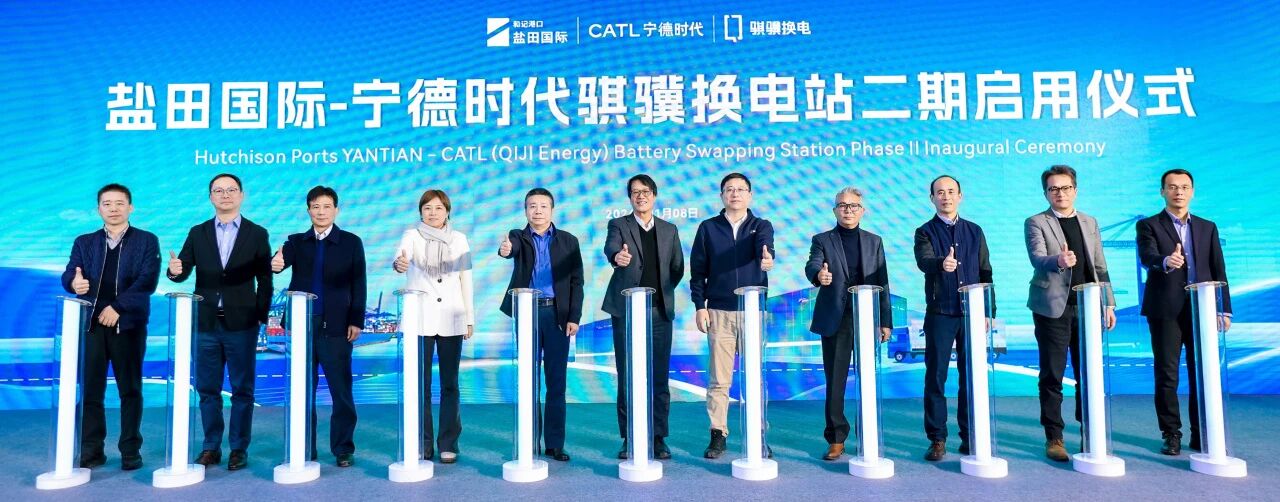
The commissioning ceremony was attended by over 100 guests, including representatives from the Shenzhen Development and Reform Commission, the Transport Bureau of Shenzhen Municipality, leaders from Yantian District, the Shenzhen Institute of Standards and Technology, the Shenzhen New Energy Storage Industry Association, as well as management teams from YANTIAN and CATL Qiji, alongside industry experts and representatives of partner enterprises.
 01 A green revolution: from "one hour" to "five minutes"
The strategic partnership between YANTIAN and CATL Qiji represents a landmark progression of the chassis-type battery swap model in port transportation, moving from pilot demonstration to large-scale application. In November 2024, the world's first on-dock chassis-type battery swap station for heavy-duty trucks was put into operation at YANTIAN. Nearly 100 chassis-type battery swap heavy-duty trucks were deployed in the initial phase. By adopting the battery swap model, the conventional charging time of more than one hour has been dramatically reduced to approximately five minutes per swap, effectively addressing critical challenges related to range and charging efficiency for new-energy heavy-duty trucks operating within ports.
Since the project entered operation, its environmental benefits have become increasingly evident. It has cumulatively reduced direct carbon dioxide emissions by approximately 5,000 tonnes, making tangible contributions to improving air quality in the port area and surrounding communities, and providing strong support for the advancement of the "Shenzhen Blue" initiative.
 02 Multi-station synergy delivering scaled growth in just one year
Building on the successful operation of the initial phase, the two parties accelerated the replication and expansion of the chassis-type battery swap model. In just one year, the project achieved a decisive transition—from a single-station pilot to multi-station synergy and large-scale operation. As part of Phase II, Battery Swap Stations No. 2 and No. 3 were commissioned simultaneously. Together with the first station, three battery swap stations are now operating within the port, providing battery swap services for over 250 chassis-type battery swap heavy-duty trucks and progressively establishing an efficient, reliable, and green battery swap network for new-energy heavy trucks.
With Phase II fully operational, the project is expected to reduce annual fuel consumption by approximately 6,000 tonnes and cut direct carbon dioxide emissions by around 15,000 tonnes per year, offering strong support for the development of a low-carbon port logistics system and for China's dual-carbon goals.
Lawrence Shum, Managing Director of Hutchison Ports YANTIAN, commented, "As a pioneer in low-carbon port development, YANTIAN is the world's only container terminal that has received the Best Green Container Terminal award for four times. Low-carbon development has long been embedded in our core corporate strategy, guiding a development path where efficiency enhancement and carbon reduction advance in parallel. Over the past decade (2014–2024), while our annual throughput increased by 25%, carbon emissions per container fell by 32%, achieving growth without proportional carbon growth. Last year, emissions per container reached a historic low. Following the achievement of 100% shore power coverage at berths—while remaining the single terminal with the largest shore power supply volume nationwide—the large-scale deployment of chassis-type battery swap heavy-duty trucks within the port represents another key initiative through which YANTIAN is cultivating new quality productive forces tailored to local conditions. Shenzhen serves as a key gateway for China's unwavering commitment to an open, mutually beneficial development strategy. As a core component of Shenzhen Port, YANTIAN will continue to ensure efficient port operations and the smooth, stable functioning of global industrial and supply chains, while actively advancing the application of clean energy and low-carbon technologies in port scenarios, striving to deliver lower-carbon and higher-efficiency logistics services to customers worldwide."
Zhu Zhengliang, Deputy General Manager of CATL Qiji, added, "As a major hub in global container transportation and a recognized benchmark for green development, YANTIAN's pursuit of excellence and sustainability aligns closely with CATL's strategic mission to drive the global energy transition. The commissioning of Phase II represents a tangible outcome of commercial and ecosystem innovation under our collaborative model. From an operational perspective, both efficiency gains and carbon reduction impacts have been substantial. The three battery swap stations now function as an integrated network, capable of meeting the high-intensity, round-the-clock operational demands of port tractors."
 03 Beyond battery swapping: YANTIAN's strength as a green global hub
Beyond its ongoing efforts to advance smart port development and increase capital investment, YANTIAN continues to expand and densify its service network, rail-sea services, and feeder services. Through this integrated approach, the port is further strengthening its role as a comprehensive logistics hub, fully leveraging its function of connecting domestic markets with international markets to provide international trade enterprises with stable, efficient, and low-carbon import and export channels. As one of the world's largest single container terminals, YANTIAN partners with the world’s major shipping lines to provide approximately 100 shipping services every week, linking destinations worldwide. By working in close coordination with shipping lines, government authorities at all levels, and port supervisory authorities, YANTIAN delivers high-frequency, extensive, faster, and high-efficiency logistics services.
As an international shipping hub of the Greater Bay Area, YANTIAN has consistently advanced the development of a world-class green port. It is the only container terminal to have received the Best Green Container Terminal award four times, and is China's largest single container terminal in terms of shore power capacity and berth coverage—accounting for approximately one quarter of the nation's total shore power supply. Over the past decade (2014–2024), YANTIAN has achieved growth without carbon growth. While annual throughput increased by 25%, carbon emissions per TEU fell by a remarkable 32%. Building on last year's doubling of both shore power connections and electricity supplied, these two indicators reached new highs again in the first half of 2025, each posting year-on-year growth of over 20%.
 04 A promising future lies ahead as we continue our journey toward a greener tomorrow
YANTIAN will further accelerate the transition to clean energy by deploying additional clean-energy equipment and expanding green logistics corridors. These initiatives will strengthen the port's progress in digitalisation, intelligent operations, and sustainable development, ensuring a strong and steady start to the 15th Five-Year Plan. In this way, YANTIAN will make meaningful contributions to China's dual carbon goals and the high-quality growth of international trade.